
The Vagus Nerve (Cranial Nerve X): Anatomy & Function
The vagus nerve—from the Latin “vagus”, meaning “wandering”—is the tenth cranial nerve (CN X) and the longest and most complex of the cranial nerves. It carries both sensory, motor, and parasympathetic fibers, linking the brain to the heart, lungs, and digestive tract, and plays a central role in autonomic regulation, emotional balance, and visceral communication.
Origin and Pathway
• The vagus nerve originates in the medulla oblongata, within the brainstem.
• It arises from several nuclei
• Dorsal motor nucleus of the vagus – provides parasympathetic (visceral motor) output
• Nucleus ambiguus – provides motor fibers to muscles of the pharynx and larynx
• Nucleus tractus solitarius (NTS) – receives visceral sensory input
From the medulla, the vagus exits the skull via the jugular foramen, traveling downward through the neck, thorax, and into the abdomen, giving off multiple branches along the way.
Branches and Innervations
As it descends, the vagus nerve gives rise to several important branches, each serving distinct regions and functions:
1. Auricular Branch (Arnold’s Nerve)
Provides sensory innervation to a small portion of the external ear and external auditory canal.
2. Pharyngeal Branches
• Arise in the neck region.
• Supply motor fibers to most muscles of the pharynx and soft palate (except the stylopharyngeus, innervated by CN IX, and tensor veli palatini, by CN V3).
• Play a vital role in swallowing and speech resonance.
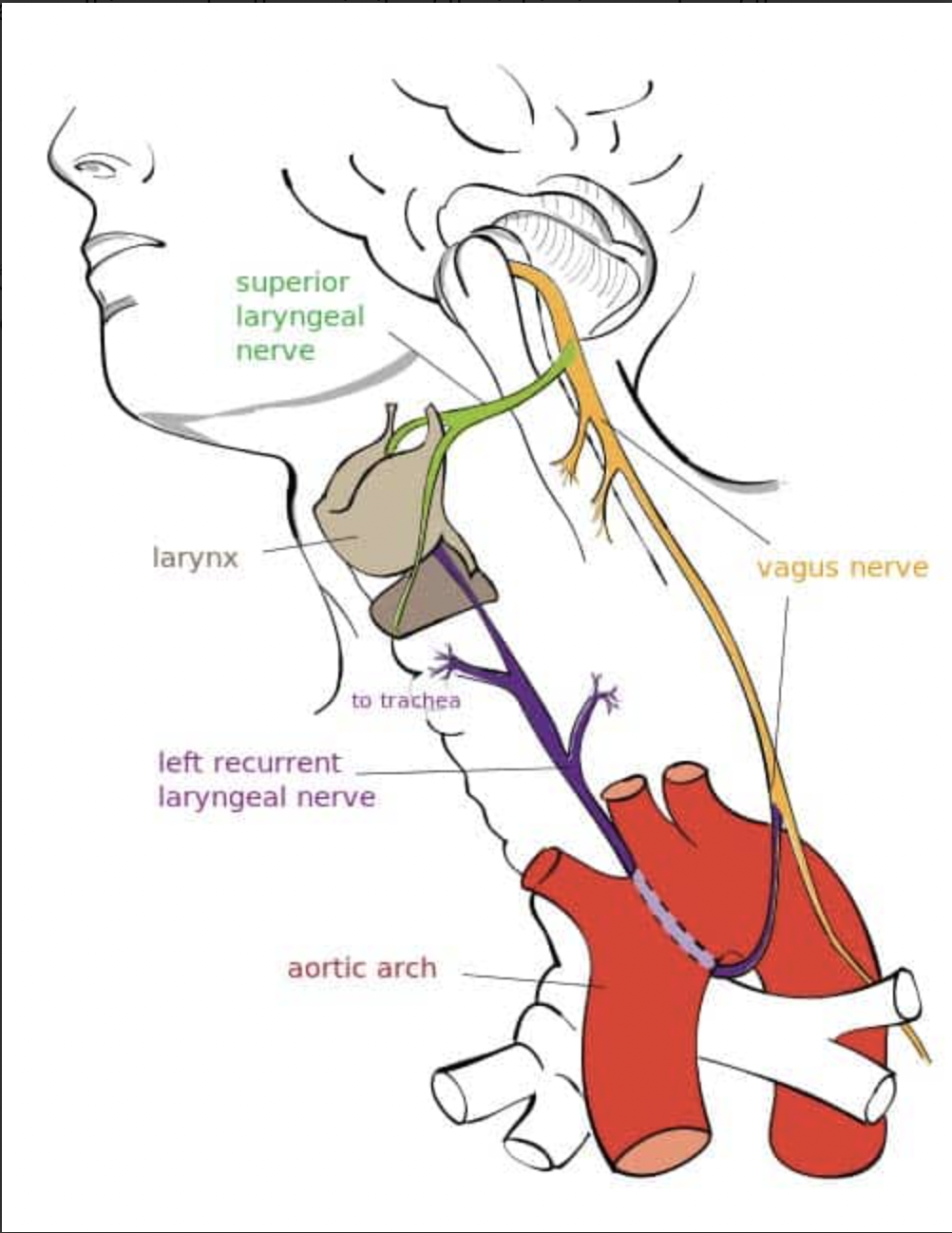
3. Superior Laryngeal Nerve
Divides into:
• External branch: motor to the cricothyroid muscle (tenses the vocal cords)
• Internal branch: sensory to the laryngeal mucosa above the vocal cords
4. Recurrent Laryngeal Nerve
Loops differently on each side:
• On the right, it wraps around the subclavian artery
• On the left, it loops under the aortic arch
• Ascends back up to the larynx, providing:
• Motor innervation to nearly all intrinsic laryngeal muscles
• Sensory fibers below the vocal cords
This branch is essential for phonation (voice) and airway protection.
5. Cardiac, Pulmonary, and Esophageal Branches
In the thoracic cavity, the vagus contributes parasympathetic fibers to:
• Heart – slows heart rate and regulates cardiac rhythm
• Lungs – constricts bronchi and modulates respiratory patterns
• Esophagus – controls smooth muscle for swallowing and peristalsis
6. Abdominal Branches
• Pass through the esophageal hiatus of the diaphragm, forming the anterior (mostly left vagus) and posterior (mostly right vagus) vagal trunks.
• These supply parasympathetic innervation to:
• Stomach and intestines up to the transverse colon
• Liver, pancreas, and kidneys (in part)
The vagus nerve thus plays a profound role in gut motility, secretion, and visceral sensation—forming a key component of the gut-brain axis.
Physiological Functions
• Parasympathetic Regulation: Slows heart rate, stimulates digestion, promotes glandular secretions.
• Sensory Input: Conveys information from thoracic and abdominal organs to the brainstem.
• Motor Output: Controls muscles for speech (phonation) and swallowing.
• Inflammatory Modulation: Through the cholinergic anti-inflammatory pathway, the vagus helps regulate immune responses.
Holistic Integration
From a mind-body and energetic perspective, the vagus nerve is the bridge between the brain and body, translating emotional states into physiological responses. Practices like meditation, gargling, singing, chanting, polarity therapy, and craniosacral work stimulate vagal tone—enhancing the body’s capacity for calm, healing, and balance.